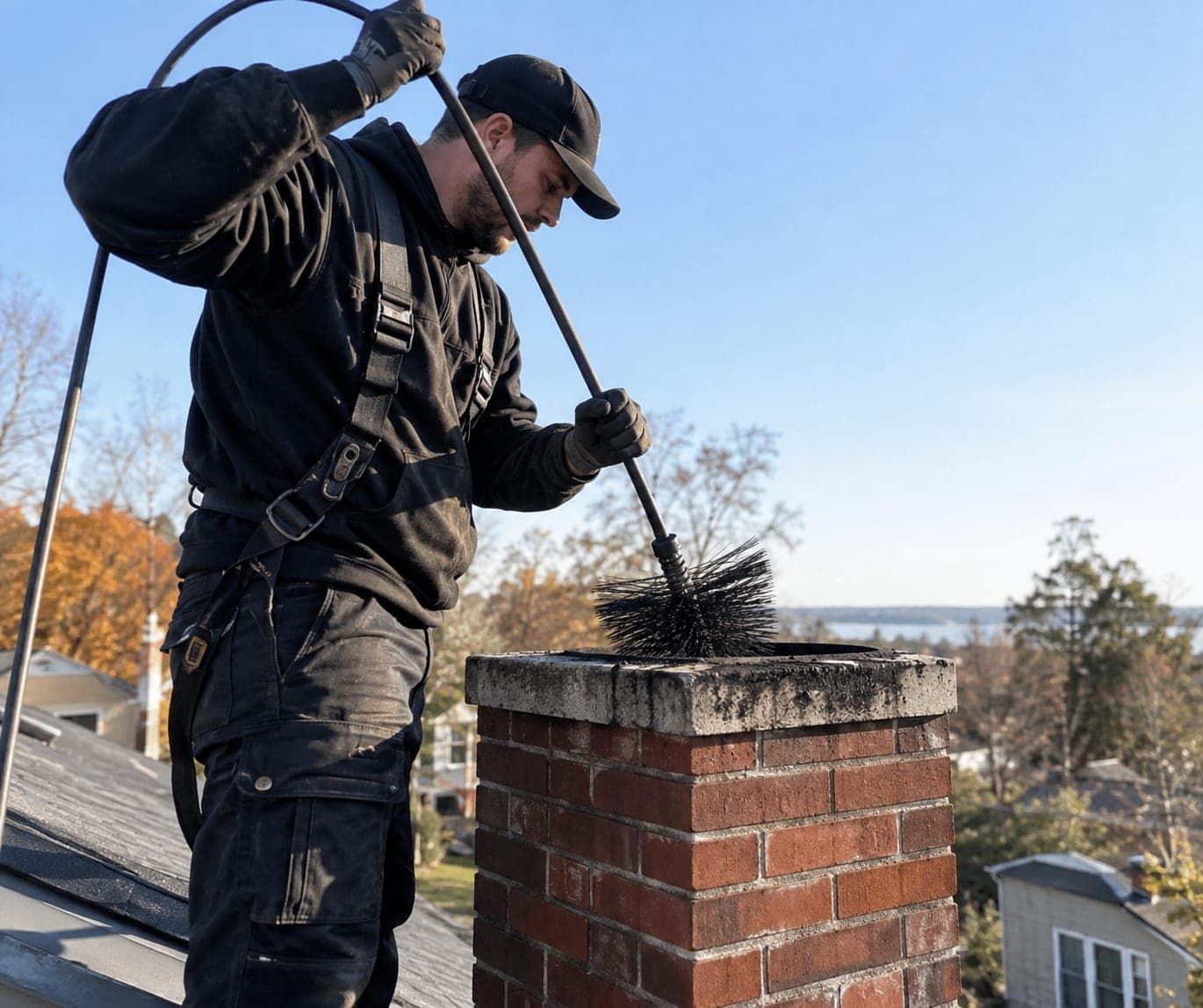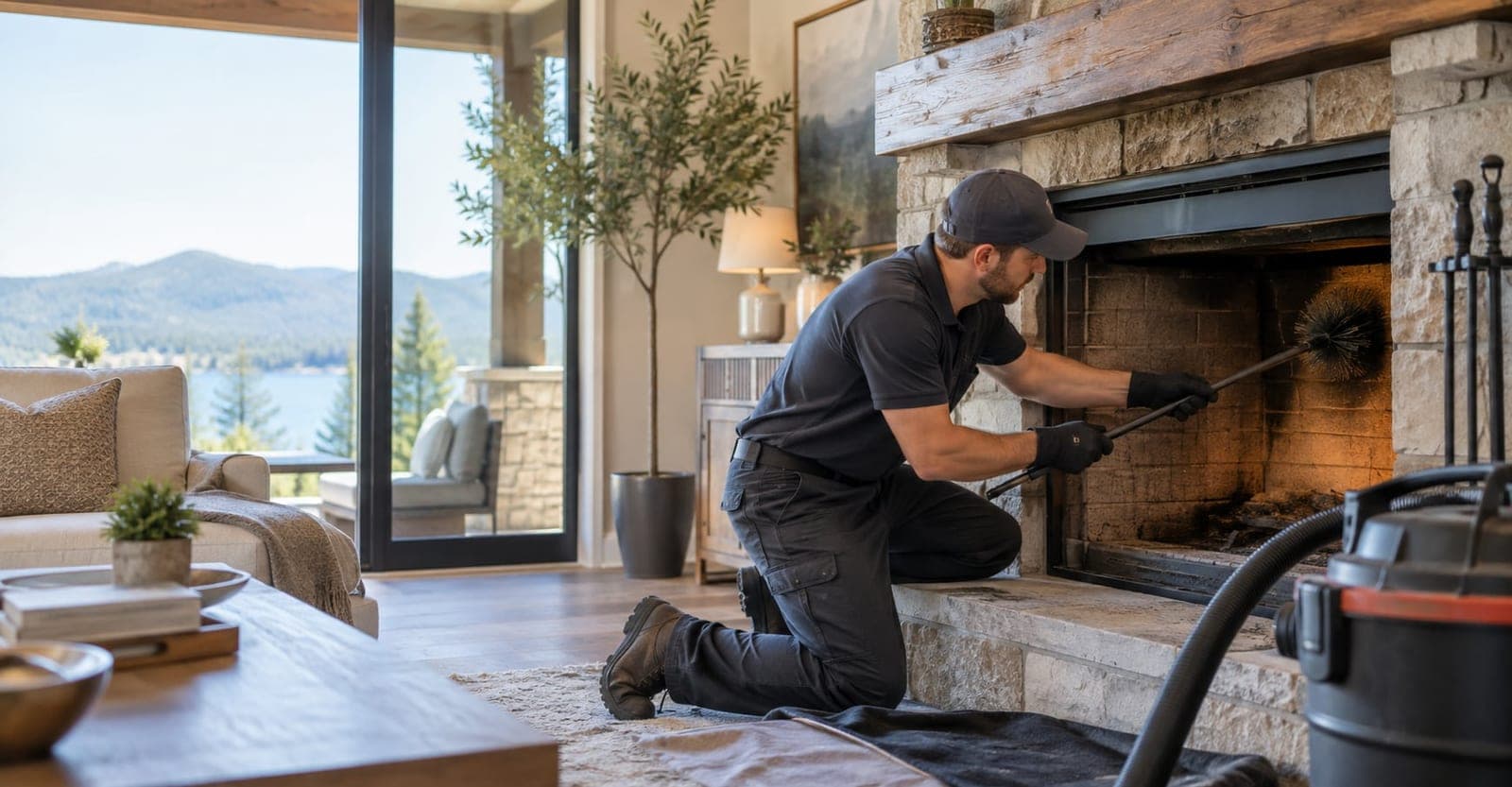
Sweeping depends on what's burning
Asking for a sweep covers several different jobs. The tools, access points and time involved change with the appliance, so it helps to know which one you have when you call.
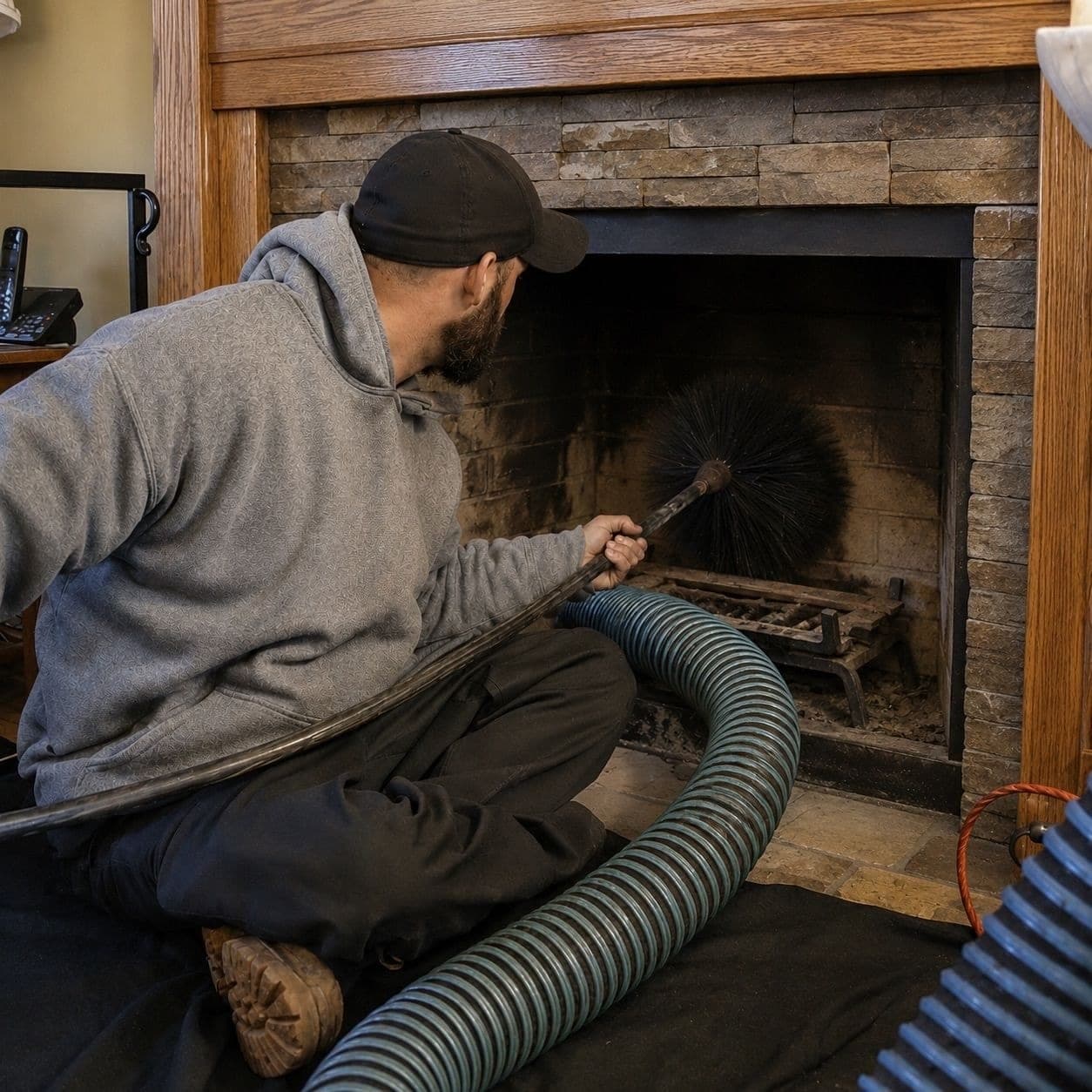
Open masonry fireplaces
The classic brick fireplace has a firebox, a damper, a smoke chamber that funnels into the flue, and usually a clay tile liner. Sweeping covers the whole run, and the smoke shelf behind the damper gets cleared too, since debris settles there and doesn't always fall clear on its own.
Fireplace inserts
An insert sits inside an existing fireplace and usually vents through a stainless steel liner. Depending on the installation, cleaning may mean disconnecting or sliding the insert forward to reach the liner and the baffle above the firebox. Inserts often run at lower air settings, which can build creosote faster than an open fireplace.
Wood stoves
A freestanding stove adds a connector pipe between the stove and the chimney. That pipe, the stove's baffle and the flue all need attention, and the bends in the connector are where deposits like to collect.
Factory-built fireplaces
Prefab units use a metal flue specified by the manufacturer. Brushes are matched to that material so the inside isn't scratched or damaged during cleaning.
What a sweep fixes, and what it doesn't
A thorough cleaning solves a lot, but it isn't a cure for everything. Here's where sweeping ends and other work begins.
| Finding | Handled by sweeping? | If not, the next step |
|---|---|---|
| Soot and flaky creosote | Yes | None needed |
| Glazed, tar-like creosote | Not with standard brushes | Creosote removal |
| Nest or debris jam in the flue | Small debris, yes | Blockage or animal and nest removal |
| Cracked flue tiles | No | Liner repair or a new liner |
| Damper that won't seal | No | Damper repair |
| Missing or rusted cap | No | Cap installation or replacement |
When repair work is needed, the estimate is free and the decision is yours.
Sweeping in Bloomfield
Bloomfield's 2025 Census estimate puts the population at 22,267, and the town is about six miles from Hartford. We sweep fireplaces, inserts and stoves here, offer same-day service where the schedule allows, and take emergency calls 24 hours, Sunday through Friday. The town page lists the rest of our service in Bloomfield, and the main chimney sweep page covers the job in detail.
Nearby, we also cover sweep for homes in West Hartford and sweep in Newington.
What happens during the visit
Buildup narrows the flue, so smoke drafts poorly and can spill into the room. Creosote is flammable: a thick layer is the usual fuel for a chimney fire.
Set up
The hearth area is covered and a vacuum keeps dust under control while the flue is open.
Check the system
The damper, firebox walls and the visible flue liner are looked at before any brushing.
Clear the deposits
Soot and creosote are removed from the liner, smoke shelf and smoke chamber.
Finish and report
The area is cleaned up and you get a plain summary of the chimney's condition.
How to prepare
- Clear a few feet of space in front of the hearth or appliance.
- Make sure the technician can reach the roof or attic access if it's needed.
- Note the make and model of any insert, stove or gas unit if you have it.
- Write down what you've noticed and when it happens — smells, smoke, sounds or stains.
What gets checked
- Visible liner sections for cracks or gaps
- Damper opening, closing and seal
- Smoke shelf and smoke chamber
- Cap and screen condition, where it can be seen safely
- Signs of animals or nesting material
- Draft — how readily smoke moves up the flue
- Creosote level and type in the flue
When to book chimney sweep
- A campfire or tar smell from the fireplace, especially on warm or damp days
- A full burning season since the last cleaning
- Soot marks on the face of the fireplace above the opening
- Scratching or chirping sounds, or debris falling into the firebox
Sources (2)
Every Bloomfield figure above, with its source.